
Is the Willamette Treatment Plant being built to support data centers in Eugene?
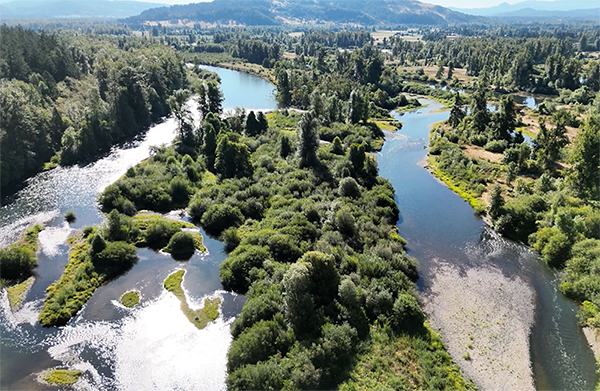
Photo: Confluence of the Coast and Middle Forks of the Willamette River upstream of the proposed intake for the new Willamette Treatment Plant.
--
On July 14, 2026, the City of Eugene received a zone verification request related to the potential development of a data center at the old Hyundai/Hynix campus on Willow Creek Circle in west Eugene. Earlier the same month, EWEB commissioners voted to move forward with plans to build a second water treatment plant for Eugene on the Willamette River. With both actions happening in close succession, the question has arisen: Is EWEB building a second water treatment plant for the proposed data center?
The answer is no.
What is EWEB’s current water treatment capacity?
The capacity of EWEB’s existing water treatment plant, Hayden Bridge, is 80 million gallons a day (MGD) and EWEB has water rights on the McKenzie River up to 120 MGD. Eugene’s peak water demand is approximately 50 MGD in summer months when outdoor water use is at its highest. EWEB is able to serve continued growth in our community, whether from residential, commercial or industrial development, with our existing water source and treatment plant.
If current capacity far outpaces our projected demand, why is EWEB building a second treatment plant?
EWEB is investing in a second plant to (1) enable critical maintenance at our existing sole treatment plant and (2) protect the community from extended water outages during disasters.
Why is a second plant needed for system maintenance?
Every drop of water that comes out of a tap in Eugene first goes through the Hayden Bridge Filtration Plant. The plant has been in continuous service for 76 years and will require maintenance and repairs that can only be accomplishedthrough downtime. EWEB cannot take Hayden Bridge offline without a second plant to produce water to meet Eugene’s needs. Building a second plant will enable critical maintenance and repair work at Hayden Bridge to extend its useful life. This is a major driver of the project.
How does our single-source status increase our risk for extended water outages?
Because EWEB relies on a single source of water and single treatment plant, we are vulnerable to experiencing an extended water outage due to natural and human-caused disasters. For example:
-
A chemical spill in the McKenzie could force EWEB to shut down our intake on the McKenzie River making us unable to produce water. If a contaminant got through the intake and into the plant, cleanup could be a long process.
- An earthquake is expected to make Hayden Bridge inoperable. Without a functioning plant, EWEB would not have a way to produce water for the city. And if we were unable to pump water into the system from a functioning plant, we could not identify and repair pipeline ruptures, which would slow the recovery effort significantly.
These are not just theoretical risks. EWEB has had several close calls with our water system that make a second source and treatment plant an urgent need. For example:
-
The evacuation zone for the Holiday Farm Fire was across the river from Hayden Bridge. Because of the plant’s age, it cannot be operated remotely for extended periods, so if staff had to evacuate, the plant would have likely been shut down, leaving Eugene without water.
-
During the 2024 ice storm, EWEB lost all three sources of power to the plant, forcing staff to run the plant at reduced capacity on an emergency generator for the first time in its history. Had the outage come during a heavy use water period, EWEB would not have been able to meet demands at the reduced capacity supported by the generator.
Is having multiple water sources a best practice for a city of Eugene’s size?
Yes. Most large utilities have multiple sources of water, just as they have multiple sources of power. Redundancy serves two purposes: it allows a utility to take a source or treatment plant offline for routine maintenance without disrupting service, and it protects the community from extended outages when disaster strikes. Any narrative tying the plant to data centers is misinformation.
Questions? Reach out to the team at WillametteWTP@eweb.org.