
EWEB Completes 16-acre Timber Harvest at Leaburg Forest
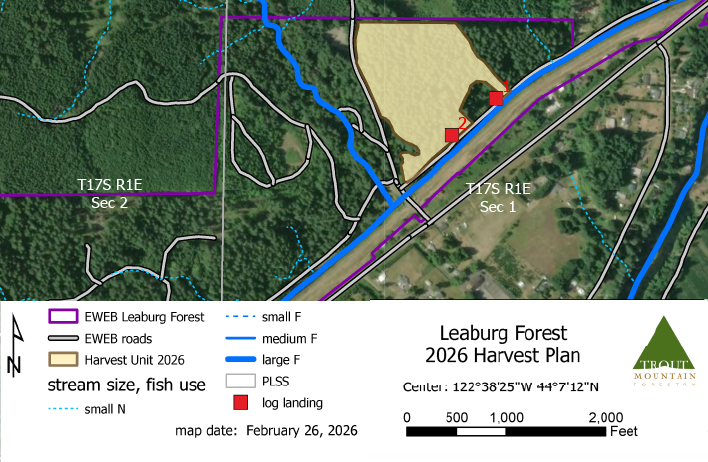
EWEB’s contracted Leaburg Forest stewardship manger completed a 16-acre timber harvest on Friday, June 11 – two weeks ahead of schedule.
EWEB and its forest managers finished the “variable retention” harvest, cutting primarily soft wood trees such as Douglas fir and Western hemlock while leaving clusters of other trees to preserve habitat.
Proceeds from timber sales will be reinvested into managing the 965-acre forest. The property needs road and culvert improvements as part of reducing erosion impacts to local waterways. EWEB is also committed to invasive species control to prevent Leaburg Forest from spreading species such as Scotch broom and exotic blackberry species.
EWEB purchased the Leaburg Forest in the 1920s as part of the development of the Leaburg Hydroelectric Project. Its 965 acres are spread out across several properties, but the primary parcel sits upslope of the Leaburg Canal. EWEB acquired the land to protect the project from landside risks.
Although the Leaburg Canal is out of service, EWEB continues to manage the Leaburg Forest to mitigate landslide hazards. It is important to properly manage the lands and forests upslope of the Leaburg Canal while there is still potential slope instability risk.
Over the past decade, EWEB implemented a stewardship plan as part of the Healthy Forests Clean Waters Program, managing the forest to demonstrate conservation-based forestry practices for protecting the excellent water quality of the McKenzie River.
The stewardship plan also promotes habitat diversity by varying stand ages and species. The recent cut left 30% of the harvest area as individual leave trees or groups to provide long-term structural diversity and habitat opportunities. Individual leave trees are generally the dominant component of the stand with large diameters and deep crowns or may be large individuals infected with rot or heavy defect, indicating value as wildlife trees.
Following harvest, the site will be replanted.
As is common with timber operations, slash piles will be burned later this fall once the fire season has ended and weather conditions are favorable. EWEB will notify the community of the timing of slash burning.
Invasive species removal will follow EWEB’s company-wide Integrated Vegetation Management (IVM) methods, which includes a holistic approach utilizing cultural, mechanical, manual, biological, and chemical strategies.
When herbicides are deemed necessary, IVM measures limit the quantity, concentrations and toxicity of products applied. Other herbicide policies include licensed applicators using naturally derived herbicides when feasible, least-toxic chemicals, timing their application for maximum benefit and with due regard to weather conditions, and using safe application techniques.