
EWEB balances water resiliency and financial health on second water treatment plant
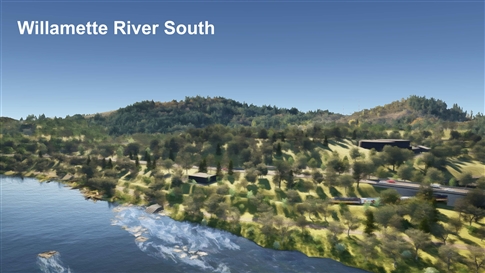
Elected Commissioners for the Eugene Water & Electric Board (EWEB) opted to move forward with planning for a 19.4 million gallon per day (MGD) drinking water treatment plant during their regular meeting Tuesday night.
EWEB is now in the process of determining how to finance this investment and the resulting impact on customer rates.
The Board of Commissioners weighed both a 30 MGD plant and a 19.4 MGD plant Tuesday. Ultimately, Commissioners chose to move forward with the 19.4 MGD plant, which balances the community’s long-term needs for water resiliency with the utility’s financial health.
Currently, EWEB relies on one 76-year-old water treatment plant — the Hayden Bridge Water Filtration Plant, on the McKenzie River — to serve 200,000 people in the Eugene area. Eugene needs a second plant on the Willamette River to allow EWEB to take Hayden Bridge offline for critical repairs, as well as to serve as a backup if a disaster strikes.
The Willamette Treatment Plant project is the largest water construction project in recent memory.
A month ago, at the July meeting, Commissioners set a preliminary direction for a 30 MGD plant, pending further financial analysis. That analysis yielded key insights: The 30 MGD plant would stress the utility’s finances, leaving little breathing room to pay for unforeseen emergency repairs for other elements of the system.
On Tuesday, Commissioners opted to shift the focus to a 19.4 MGD plant, favoring financial flexibility over the added capacity offered by the larger 30 MGD option. Notably, EWEB already holds the water rights needed for a 19.4 MGD plant, while the additional rights required for the larger option remain uncertain in both availability and cost.
“Both options are expensive, and we recognize that. However, a 30 MGD plant would have placed extreme financial strain on the utility’s financial health,” said EWEB Chief Financial Officer Deborah Hart. “Based on the cost estimates we have today, the 19.4 MGD plant puts us on a more sustainable path, with lower financial risk, while still meeting our needs for water resiliency.”
At this stage of the process, the projected all-in costs for both plant sizes — including construction, contingencies, consultants, overhead and assumed price increases from inflation — differ by roughly $67 million: $431 million for a 19.4 MGD plant compared to $498 million for a 30 MGD plant. The lower price tag of the 19.4 MGD plant is enough to bring key financial metrics closer to utility targets, making the smaller plant a more financially sound choice. EWEB will select a Construction Manager/General Contractor to develop a guaranteed maximum price for Board approval before construction begins.
While the 19.4 MGD plant meets the community’s water resiliency needs for the foreseeable future, 30 MGD remains EWEB’s long-term buildout goal for this facility.
“With a 19.4 MGD plant, we can better balance financial risk and operational risk, positioning our community to recover more quickly after a major disaster,” Hart added. “Starting with a smaller plant today means that expanding to full 30 MGD capacity will be a future undertaking.”
A second plant makes Eugene’s water system more resilient to disaster.
The dependence on one water source and one treatment plant creates a single point of failure, leaving Eugene vulnerable to a prolonged water outage. Among major cities in the Pacific Northwest, Eugene is one of the few that relies on only one drinking water source.
Those vulnerabilities have become increasingly apparent in recent years.
During the 2020 Labor Day wildfires, EWEB came close to evacuating Hayden Bridge. Because the facility cannot be operated remotely for long periods, an evacuation could have interrupted water production. As climate change contributes to hotter, drier summers, the likelihood and severity of wildfires are expected to increase.
The January 2024 ice storm also exposed the system's vulnerability. The storm disabled all three electrical feeds serving Hayden Bridge, forcing the utility to rely on backup diesel generators for the first time in the plant's history to continue delivering safe drinking water.
The McKenzie River also faces ongoing threats from transportation-related spills. Truck crashes and tanker accidents periodically release diesel fuel and other contaminants into the watershed. In May, for example, a tanker truck spilled diesel fuel and milk into a tributary of the McKenzie River.
In addition, a major Cascadia Subduction Zone earthquake is expected to leave EWEB's only water treatment plant inoperable. Such an earthquake will also cause major damage to EWEB’s water distribution system. But EWEB won’t be able to begin repairs to pipelines throughout the city unless it has an operable water treatment plant to pressurize pipes and detect leaks.
EWEB estimates that a citywide water outage would result in economic losses to the local community totaling tens of millions of dollars each day.
The 19.4 MGD plant balances financial resiliency and operational necessity.
The 19.4 MGD plant will offer most of the same benefits as the 30 MGD plant, while leaving more room for financial contingencies.
The 19.4 MGD plant, for instance, still puts EWEB’s Willamette River water rights to beneficial use and protects them in the future. It also allows EWEB to take its current treatment plant, the 76-year-old Hayden Bridge Water Filtration Plant, offline for a few months of the year to perform critical inspections and strategic repairs.
However, financing a 30 MGD plant would require debt levels that push EWEB towards the limits of its borrowing capacity, reducing the ability of the utility to finance other projects, both foreseen and unforeseen.
This matters because some significant costs are not yet accounted for in the 10-year capital plan, such as significant future investments at Hayden Bridge and in obtaining additional water rights on the Willamette River.
Choosing the smaller plant preserves financial capacity to absorb these unknowns and other infrastructure investments, as they become clearer.
“When we looked closely at the financial implications of the larger, 30-MGD plant, it felt like mortgaging our future, and that’s not a risk we’re comfortable taking,” said EWEB General Manager John Hairston. “The 19.4-MGD plant reflects a prudent middle path: sufficient capacity to provide the resiliency we need, without the financial strain that a more expensive plant would cause.”
EWEB delays other construction projects to fund the treatment plant.
To make room for the second water treatment plant in the budget, EWEB is deferring $36 million of other construction work for three to five years.
Those projects include two river crossing pipeline projects, two small reservoir projects that serve high-elevation customers and two transmission main replacements at Hayden Bridge.
These deferrals reflect careful consideration of how projects interconnect and are sequenced across the water system. For example, once the new Willamette Treatment Plant is online, EWEB will be able to deliver water to base-level reservoirs without crossing the river, allowing two river crossing projects to be pushed out. EWEB has four total river crossings making the deferrals tenable considering the resiliency provided by the new plant.
These deferrals do carry some risk: as infrastructure ages, pipes threaten to rupture and repairs grow more frequent. EWEB will continue to monitor these assets closely and, with the financial flexibility of a smaller treatment plant, can prioritize the work sooner, if needed.
Paying for the second treatment plant will consume two-thirds of the construction budget for the water utility for the next 10 years, representing a once-in-a-generation investment in securing a resilient water supply for the community.
“Investing in water is not just a cost to bear – it is a tangible opportunity to strengthen our community’s quality of life, public safety, economic vitality,” said Chief Water Operations Officer Karen Kelley. “Every dollar spent upgrading pipes, treatment plants, and distribution systems reduces the likelihood of costly main breaks, boil-water advisories, and service outages that disrupt lives and cost millions.”
In the next few months, EWEB will calculate how the costs of building the plant will be spread out over the next 10 years and how it will divide up the costs among customers.