
EWEB concrete, copper and steel ensure reliable, resilient delivery of water and power
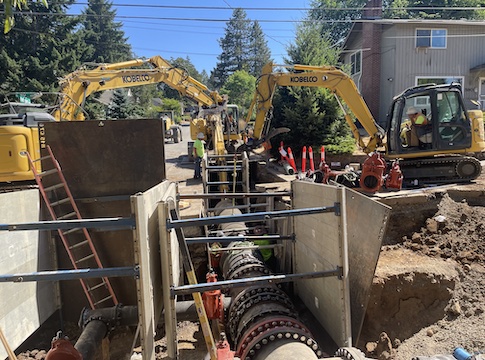
Flip the switch or turn on the tap, and the power and water flow. Easy, right? But behind that ease and simplicity, a vast network of infrastructure worth about $1.5 billion is hard at work, ensuring that life-sustaining water and power are always available.
From source to switch and source to tap, that infrastructure requires maintenance and investment. Just like EWEB customers of generations past, EWEB customers today invest in infrastructure to foster future resiliency for decades to come.
This year, EWEB's electric infrastructure budget totals $109 million for maintaining, upgrading, and expanding the system our community depends on, while the water infrastructure budget is $55 million.
While maintaining and expanding infrastructure at this scale requires significant investment, EWEB is committed to operating as efficiently as possible and planning carefully around what our community can afford. We don’t take lightly the balance between keeping costs manageable and delivering the reliable services our customers count on.
When you add it all up, the average Eugene household pays about $9 a day for both water and electricity. That covers all the infrastructure, staff, and services that keep the lights on and the water flowing.
The infrastructure behind your tap and light switch took generations to build. Together, we’re making sure the next generation inherits something just as solid.
Electric infrastructure keeps the power flowing from source to tap
On the electric side, EWEB recently completed a major rebuild of a cornerstone of the utility’s local power generation: the Carmen-Smith powerhouse. Seventy miles east of Eugene on the McKenzie River, EWEB owns and operates a hydropower project that can provide 6-9% of Eugene’s electricity each year.
High-voltage transmission lines are necessary to bring electricity from Carmen-Smith — and other sources — to homes and businesses in Eugene. In December last year, a storm caused one of EWEB’s transmission lines near the McKenzie River to topple. In recent years, the river had moved closer to the original placement of the poles, making them less stable during high water flows. A short-term fix enabled EWEB to keep the power flowing, but a long-term solution is also warranted.
That transmission line connects businesses, schools, hospitals, and critical facilities — like EWEB’s Hayden Bridge Water Filtration Plant — to the grid.
Electricity flows through transmission lines to substations, which are key nodes in the grid that “step down” electricity to lower voltage that runs through local distribution lines in neighborhoods and from there to homes and businesses across Eugene.
EWEB is upgrading older substations that were originally built during an era of surging growth in the 1960s and 1970s. Specifically, in November 2024, EWEB completed the rebuild of the Currin Substation, which is the largest substation in EWEB’s system is located near Interstate 105 and Garden Way. Then, last summer, EWEB embarked on a partial rebuild of the Danebo Substation in Northwest Eugene.
Water infrastructure keeps the water flowing from source to tap
On the water side, EWEB invests millions of dollars in protecting the source of Eugene’s drinking water, the McKenzie River. In May, EWEB and its partners, including McKenzie Watershed Council and U.S. Forest Service, began a major habitat restoration project on the South Fork of the McKenzie River. The “stage zero” project will reset the river bottom along 1.8 miles and across 335 acres, returning the river to a shape more aligned with its nature contour, before people channelized it a century ago.
Water then flows downstream to EWEB’s Hayden Bridge Water Filtration Plant, where investments in treatment and testing capabilities ensure the safety of Eugene’s water supply. Last year marked 75 years of service at the historic plant. In recent years, EWEB has completed seismic upgrades, replaced the raw water intake screens, built a new settling basin and two deep bed filters, and installed a generator for backup power.
From there, treated water flows to water storage tanks strategically located at high elevations to take advantage of gravity. In 2024, EWEB finished building two new 7.5-million-gallon water storage tanks in South Eugene off E. 40th Avenue. Those tanks were necessary to enable to EWEB to take offline the historic College Hill Reservoir and replace it with two identical 7.5-million-gallon earthquake-resilient water storage tanks. At College Hill, machines are currently wrapping the tanks in high-strength, galvanized 7-strand wire to help the tank walls hold in water and ensure strength and durability during an earthquake.
Distribution pipelines carry the water from those tanks to homes and businesses across the city. Work on pipelines occurs every year. This summer, pipelines on Chambers Street and Bethel Drive will be upgraded.
And from there, the water flows, clean and reliable, in homes and businesses across the city.