
EWEB advances 2027 budget focused on community resilience
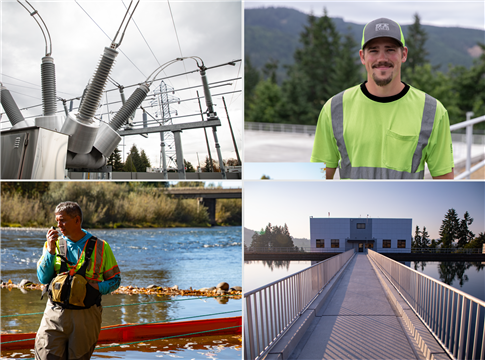
At EWEB's November 3 public board meeting, the utility's elected commissioners directed staff to move forward with a proposed 2027 budget that invests in making Eugene’s electric and water systems more resilient and increases funding for customer bill assistance.
The budget advances Eugene’s largest water infrastructure project in recent history — developing a second water source and treatment plant on the Willamette River.
Most communities Eugene’s size have more than one source of drinking water. Eugene doesn’t. The community relies on a single source and a single treatment plant, leaving Eugene vulnerable to an extended water outage if a wildfire, earthquake, severe storm or accident damages that system.
In recent months, after decades of analysis and public discussion, EWEB commissioners directed staff to proceed with planning for a second plant. That project represents about two-thirds of EWEB’s planned water infrastructure spending over the next decade; the 2027 budget funds early design and engineering.
Learn more about plans for a second water source
Other major investments include rebuilding the Jessen Substation in West Eugene, advancing federally required dam safety and fish passage at EWEB’s Carmen-Smith hydroelectric project, saving for future decommissioning of the retired Leaburg Dam and completing construction of new earthquake-resilient storage tanks and pipelines at College Hill.
Much of Eugene’s electric and water infrastructure was built in the 1960s and 70s and is reaching the end of its service life. At the same time, risks from natural and human-caused disasters are growing and straining infrastructure.
Of the $502 million total budget, about $130 million goes to projects that help Eugene’s electric and water systems withstand disruption and recover quickly when outages do occur. Roughly $333 million pays for daily operations like buying power from energy suppliers and maintaining the tools, technology and skilled workforce that keep the lights on and the water flowing. Another $39 million pays debt payments on existing borrowing.
Learn more about major projects
To soften the impact on customer bills, EWEB is deferring about $100 million in large projects over the next 10 years, pushing them further out where it is safe to do so to give customers near-term relief.
The combined electric and water monthly bill would rise about $9 for a small home or apartment, and about $18 for an all-electric single-family home. That’s about 7% in both cases. Actual bills vary by season, household size, home efficiency and daily habits. Households that use more would see larger increases.
To help customers struggling to pay their utility bill, commissioners also directed an additional $100,000 for bill assistance, bringing 2027 funding to $2.2 million. EWEB also offers zero-interest loans and rebates for upgrades that help households use less electricity and water year-round, such as new insulation, water heaters, and high-efficiency home heating and cooling systems. For income-qualified households, rebates can cover the full cost of some upgrades.
“Our customers are feeling growing affordability pressures. At the same time, we’re dealing with aging infrastructure and growing risks while federal funding is shrinking,” said EWEB General Manager John Hairston. “Balancing community priorities like reliability and affordability can require difficult choices. In building this budget, we sharpened our pencils and prioritized the most important projects to help keep utility bills more affordable for our entire community.”
As a community-owned utility, EWEB does not operate to earn a profit. Prices are based on the cost of providing service, and the budget is reviewed and approved in public meetings by five elected, volunteer commissioners. The next step is a final review and vote by the Board on Dec. 1, with another opportunity for public comment. If approved, new prices would start with bills issued on or after Feb. 1, 2027.
Related Programs

Learn more about EWEB
EWEB is a customer-owned public utility. We provide electric and water service to approximately 200,000 people in the Eugene area.

Budget and Rate Information
As a customer-owned utility, we do not operate to earn a profit. Prices are based on the costs to serve our community with safe, reliable water and electricity.