
Skip to Content

Important Notice

After Hours Scheduled System Maintenance - We will be performing after hours system maintenance on Saturday, August 22 from 8:30 p.m. until Sunday, August 23 at 8 a.m. During this time our online customer portal and payment services, including pay-by-phone and Walmart Pay, will be unavailable.

We appreciate your patience and apologize for any inconvenience this may cause.


(Close)

Related News

  • Related News

  • Is the Willamette Treatment Plant being built to support data centers in Eugene?

    No. EWEB has more than ample supply and treatment capacity on the McKenzie River to meet the city's water needs now and into the future. Any narrative tying the new Willamette Treatment Plant to data centers is misinformation.

    Find Out More
  • The Facts on Eugene's Drinking Water

    Eugene's tap water is safe and EWEB has never violated a single EPA or state drinking water quality standard.

    Find Out More
  • EWEB to maintain wildfire safety settings for south Eugene neighborhoods for the remainder of the summer

    Wildfire safety settings cause lines to operate at a higher sensitivity, increasing the likelihood of more frequent, prolonged outages.

    Find Out More
  • EWEB balances water resiliency and financial health on second water treatment plant

    The Willamette Treatment Plant is necessary to ensure a resilient and reliable source of water. EWEB Commissioners opted to move forward with planning for a 19.4 million gallon per day (MGD) drinking water treatment plant. EWEB is now in the process of determining how to finance this investment and the resulting impact on customer rates.

    Find Out More
  • What are EWEB's procedures related to large consumption customers such as data centers?

    Communities across the Pacific Northwest are grappling with requests from large consumption customers such as data centers to connect to local electric and water systems. EWEB has procedures and processes in place to ensure that we treat interconnection requests fairly and impartially, and that large consumption customers don’t pass costs on to other customers.

    Find Out More
  • Show More
EWEB will close College Hill Reservoir site for Fourth of July
June 28, 2023 Aaron Orlowski, EWEB Communications

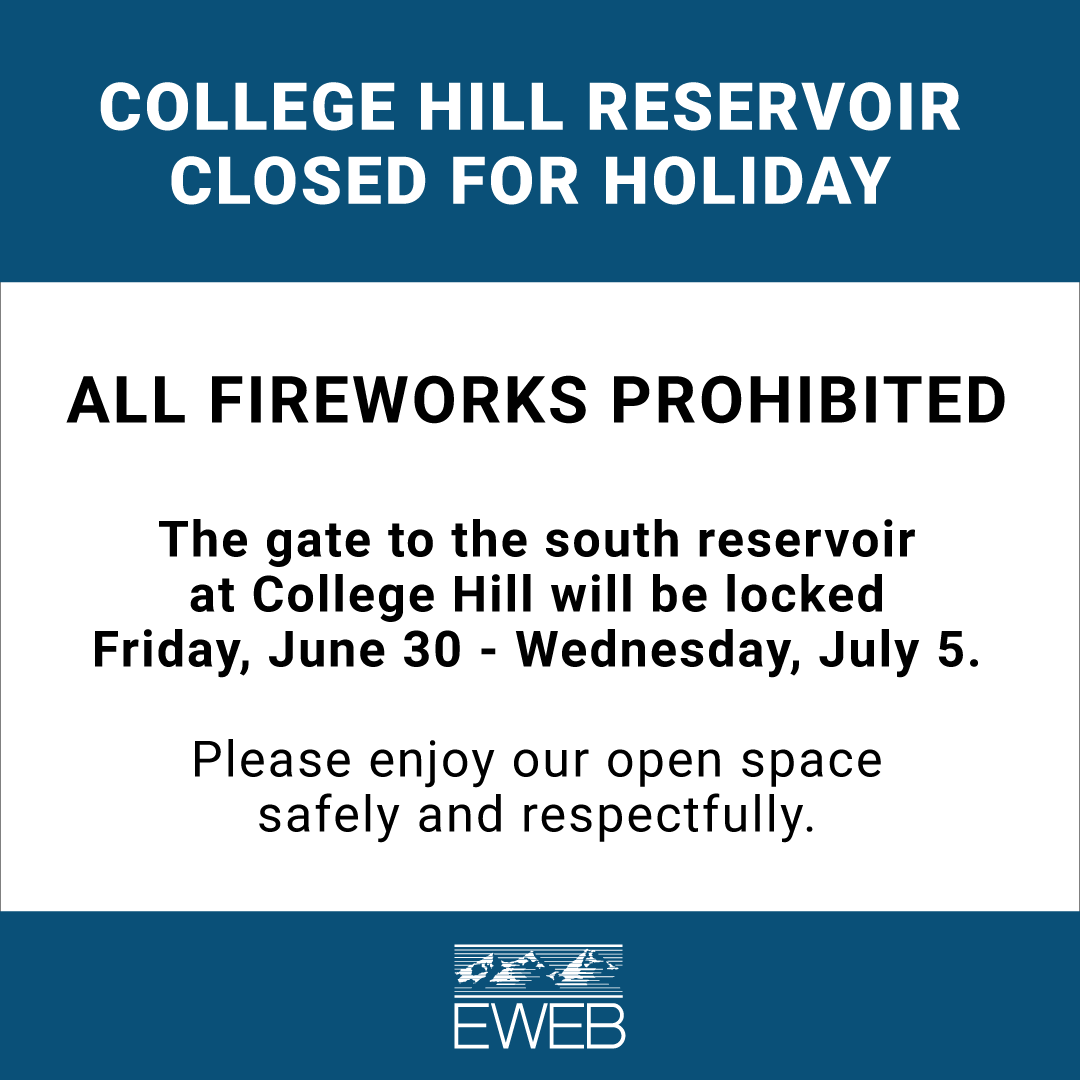
EWEB will continue the annual closure of its College Hill Reservoir over the Fourth of July holiday.

For the past several years, EWEB has restricted access to the reservoir surface around the Fourth of July to ensure people do not set off fireworks which can damage the roof and potentially impact drinking water quality.

Setting off fireworks is prohibited across the entire City of Eugene to prevent fires. Fireworks are also prohibited in Lane County open space, parks and recreation areas and in federally or state-managed areas like Bureau of Land Management, National Park Service and Oregon State Parks.

At College Hill, only the surface of the south water tank will be closed over the holiday. EWEB will lock the gates to the surface Friday, June 30. The gates will re-open Wednesday, July 5. 

EWEB invites the public to enjoy the ungated public space respectfully. 

“College Hill’s primary function, and EWEB’s top priority, is storing and protecting drinking water,” said EWEB Water Operations Manager Mike Masters. “Closing the College Hill reservoir over the Fourth of July holiday has been an effective way to protect the surface of the tank from further damage and water contamination risks.”

A volunteer neighborhood reservoir watch has been in place for years to help reduce risks to water quality from people using the water storage facility for recreation, and EWEB has invested close to $1 million over the past decade on temporary fixes to the 80-year-old facility. Despite improvements, the structure is still susceptible to contamination and has reached the end of its useful life.

Approximately 80,000 people in Eugene rely on the 15 million-gallon College Hill Reservoir for their drinking water. EWEB will dismantle the leaky and antiquated reservoir and replace it in the coming years with new, modern drinking water storage tanks built to withstand major earthquakes. Construction could begin as early as 2024.